How to Reheat Cooked Food Safely for Plate Sales
Build a safer batch-reheating workflow with verified cold storage, rapid heating, temperature checks, clear corrections, and hot-holding handoff.
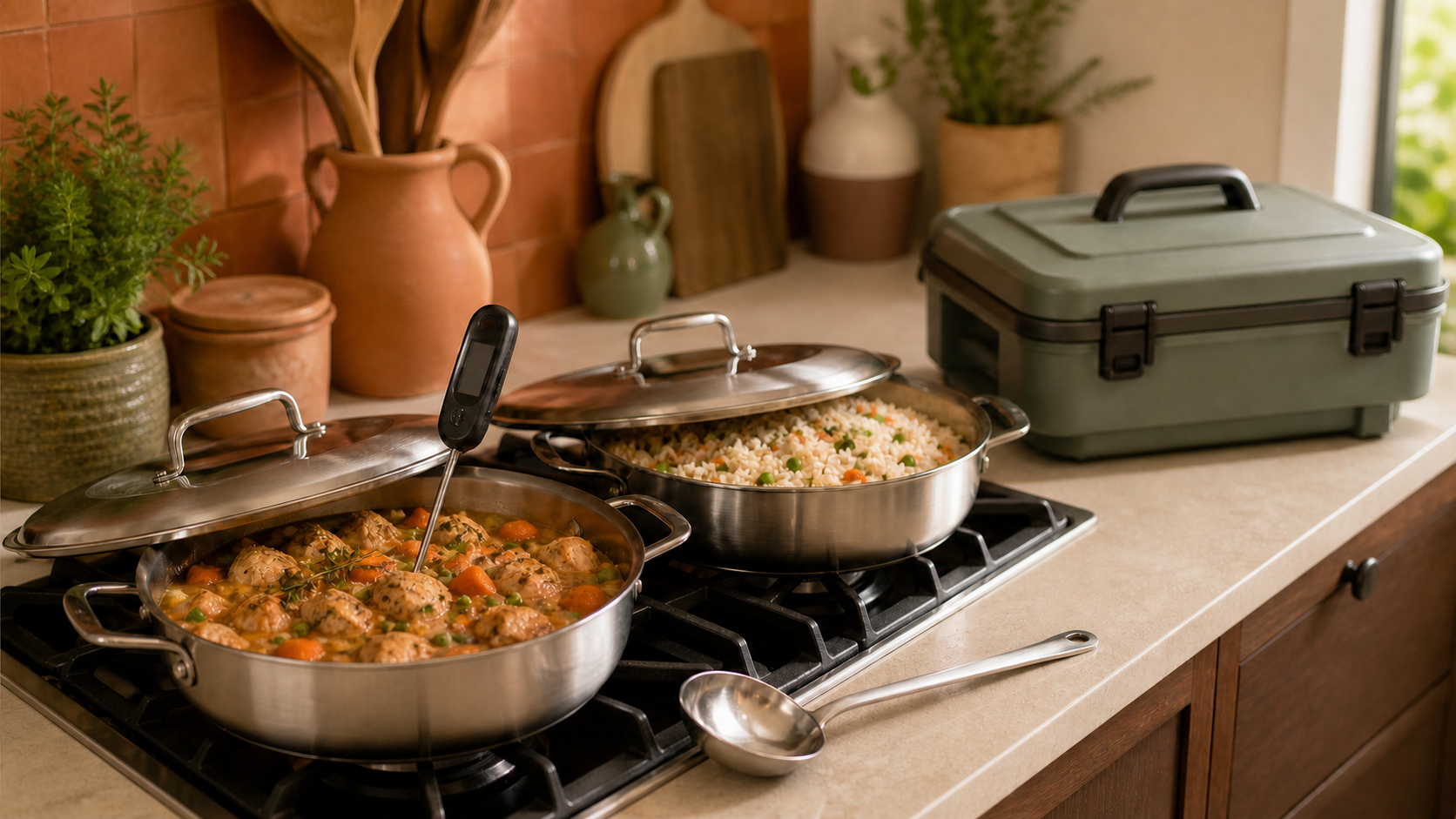
A cooked batch can cool correctly overnight and still fail on sale day if it warms slowly in a steam table or only the easy-to-reach edge is checked. Reheating is not the same as cooking a raw recipe, and it is not the same as keeping already-hot food warm. It is a separate, time-bound step between verified cold storage and hot holding.
This guide will help you release the right batch, choose equipment that heats rapidly, find the coldest parts, record the result, and move compliant food into the pickup workflow. It focuses on cooked food that was intentionally cooled and stored for reheating and hot holding.
Advance cooking and reheating may not be allowed for every food, permit, facility, or home kitchen. The FDA Food Code is a model for jurisdictional adoption, not one universal rule for every seller. Confirm that your authority permits the complete cook-cool-store-reheat-hold process and follow its current limits, equipment rules, records, and corrective actions.
Release the batch before turning on the heat
Reheating cannot repair an unknown storage history. Before a container leaves the refrigerator, match it to the production and cooling records.
Confirm:
- The product, recipe version, batch ID, and container ID are readable.
- The initial cooking step met the approved procedure.
- The batch completed every required cooling checkpoint.
- Cold storage remained within the adopted limit.
- The use-by or discard decision still permits service.
- The package is intact and shows no leak, contamination, or unexplained opening.
The cooked-food cooling workflow explains how shallow containers, measured checkpoints, labels, and corrective decisions create that history. If a cooling record is missing, a label conflicts with the schedule, or the storage temperature was uncontrolled, isolate the food and follow the approved disposition procedure. Do not “reheat it extra” and treat a high final reading as proof that the earlier history was safe.
Count only the food needed for the paid order batch. Reheating every container “just in case” creates a longer process, consumes holding capacity, and leaves you with another surplus decision after service.
Write the reheating standard for this product
In the current FDA model, time/temperature control for safety food that was cooked, cooled, and reheated for hot holding generally reaches 165°F for 15 seconds in all parts. The model also requires rapid reheating, with no more than two hours between 41°F and the required reheating temperature. Product-specific provisions apply to certain commercially processed packaged ready-to-eat foods and unsliced roasts, so one simplified rule does not fit every product.
Read the controlling details in FDA Food Code section 3-403.11, then replace the model values with the procedure adopted for your operation when it differs. Write the standard on the batch sheet before production begins:
- Required reheating temperature and holding time
- Maximum permitted reheating period
- Approved equipment and pan or batch size
- Required stirring, covering, or rotation steps
- Temperature locations and check frequency
- Action when a check is low or time is nearly exhausted
- Hot-holding destination and release temperature
Do not borrow an exception because an ingredient arrived in a sealed package. A sauce made in your kitchen, a commercially packaged soup, and a remaining roast can fall under different provisions. Use the classification confirmed for the exact finished product and process.
Use cooking equipment, not the holding unit
A warmer is designed to maintain hot food, not to move a cold, dense batch rapidly through reheating. University of Minnesota Extension warns that steam tables, warmers, and similar holding equipment do not reheat food quickly enough.
Use the stove, oven, microwave, or other cooking equipment approved for the recipe and capable of meeting the required time and temperature throughout the batch. Preheat equipment when the manufacturer and process call for it. Divide food among the tested pans rather than putting a larger-than-tested load into one vessel.
Capacity is more than whether the pan fits. Ask:
- Can heat reach the center without scorching or drying the outside?
- Can the food be stirred or rotated as required?
- Does the pan leave enough room for safe handling and a clean thermometer check?
- Can every planned batch finish before it needs the same burner, oven, or microwave?
- Is the hot-holding unit ready to receive the food immediately after release?
Put those equipment reservations into the plate-sale production schedule. If two batches need the same burner at the same time, reduce the batch size, stagger the start, use separately approved equipment, or lower the order cap. The deadline should not be solved by increasing the heat beyond the recipe or equipment instructions.
Reheat for evenness, not just speed
Different foods create different cold spots. A sauce can be cooler near the center if it is not stirred. Rice can heat unevenly in a deep pan. Chicken pieces, casseroles, and thick portions can be hot at the surface while their centers lag.
Use the recipe’s tested method:
- Start the reheating clock at the point required by your procedure.
- Cover, uncover, stir, rotate, or add an approved recipe liquid only as the method specifies.
- Keep lids, utensils, and food-contact surfaces protected from contamination.
- Check early enough to correct uneven heating before the limit.
- Continue until every required location reaches the approved temperature and hold time.
USDA consumer guidance says reheated leftovers should reach 165°F, brings sauces, soups, and gravies to a rolling boil, and emphasizes covering and even heating. Use that as supporting practice, not as a substitute for your food-business procedure.
Do not combine a cooler old batch with a fresh hot batch to lift the average temperature. Keep batch identities separate through reheating, verification, holding, and service.
Treat microwave reheating as its own method
Microwaves can leave hot edges and cold centers. In the FDA model, microwave reheating for hot holding requires the food to reach 165°F throughout, be rotated or stirred, remain covered, and stand covered for two minutes after reheating, subject to the applicable exceptions.
Build those actions into the recipe rather than relying on someone to remember them:
- Use a microwave-safe container and cover specified for the food and appliance.
- Arrange the food in a tested depth and quantity.
- Pause to stir or rotate at the written point.
- Complete the required covered stand before the final release decision.
- Check several likely cold locations with the approved thermometer.
USDA’s current answer on reheating leftovers safely also directs users to cover and rotate or stir microwave-heated food and verify 165°F in several places. If the batch is too large to heat evenly in the tested microwave cycle, divide it before starting or use another approved method.
Check the coldest locations and record the decision
Steam, bubbling edges, and an oven display are not internal temperature measurements. Use a clean, sanitized, accurate food thermometer with a sensing area suited to the food. The thermometer-checking workflow covers device accuracy, probe placement, cleaning, and records.
Choose check locations during the recipe test. For a wide pan of stew, that may include the center and another slow-heating zone after the required stirring. For multiple covered pans, check each pan under the sampling procedure accepted by your authority. Do not let one hot corner release the whole batch.
The Institute of Child Nutrition’s reheating fact sheet recommends at least two internal temperatures from each reheated batch and a record of the time and temperature. That is a useful starting control, not a universal sampling rule for every plate seller.
Use one line per batch:
| Batch | Start | Equipment and load | Temperature locations | Finish | Decision | Next step |
|---|---|---|---|---|---|---|
| Chicken stew A | 2:05 p.m. | Stovetop, one tested pan | Center and slow-heating side both compliant | 2:42 p.m. | Released | Hot hold for slot one |
That row is an example, not evidence for a particular recipe. Record actual readings, hold times, checker initials, and any correction required by your procedure.
Make the correction before the limit expires
Decide the response before food is on the heat. If one location is low but the permitted period remains, continue reheating with the approved stirring, covering, or batch adjustment and check again. If the equipment fails, the batch identity is lost, contamination occurs, or the required temperature is not reached within the allowed period, stop and follow the documented disposition—often discarding the affected food.
Do not reset the clock when food moves to a new pan. Do not record only the warmest reading. Do not transfer a failed batch into hot holding and hope the warmer finishes the job.
After the batch passes, move it promptly into the approved hot-holding and pickup workflow. Record the transfer, maintain the required holding condition, and connect each container or pan to its pickup window. Reheating completion is the handoff to the next control, not the end of temperature management.
Run a seven-point check before the next sale
Before reheating a customer batch, confirm:
- Permission: Advance cooking, cooling, storage, reheating, and hot holding are allowed for this food and facility.
- History: The batch identity, cooling record, storage condition, and use date all agree.
- Standard: The required temperature, time, method, locations, and exception status are written.
- Equipment: Tested cooking equipment can heat the planned load rapidly and evenly.
- Measurement: A verified thermometer checks the slowest-heating parts early enough to guide action.
- Correction: A low reading or missed limit leads to the approved decision, not a reset clock.
- Handoff: Released food moves directly into controlled hot holding and the correct pickup batch.
Start with one approved recipe and the batch size you actually plan to sell. Rehearse it from cold-storage release to hot-holding transfer, record the slowest location, and revise the equipment load or timing before customers are waiting. The Selling Plates guide can help connect that reheating test to the menu, order cap, pricing, and wider sale-day system.
Ready to move?
Turn the research phase into your first sale.
The guide brings pricing, menu planning, marketing, and setup into one clear playbook.
Get the guide on Gumroad