How to Cool Cooked Food Safely for Advance Orders
Build a safer batch-cooling workflow for advance food orders with shallow pans, temperature checkpoints, clear records, and honest stop decisions.
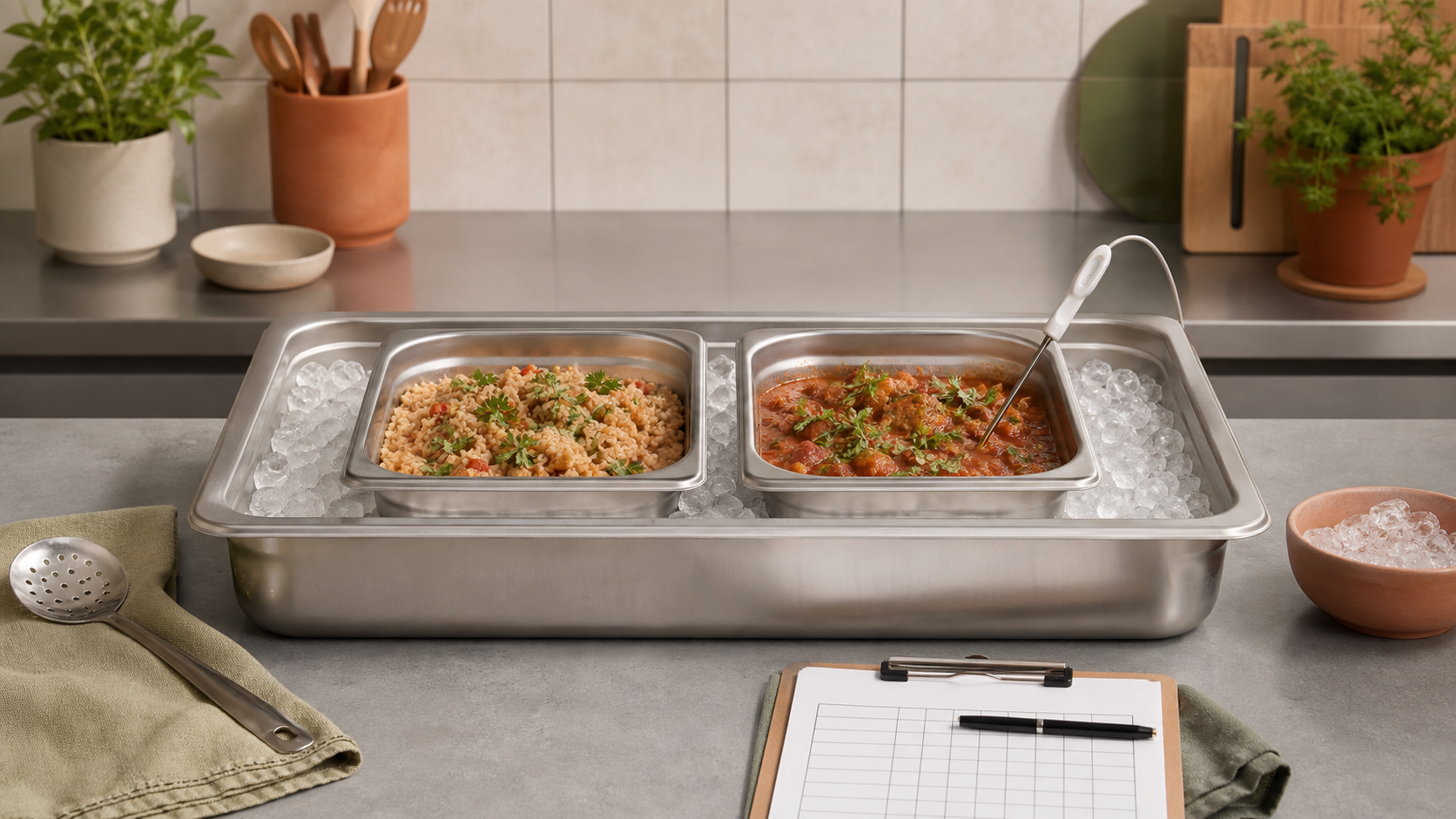
A deep pot of cooked food can still feel warm hours after it enters the refrigerator. For a plate seller preparing ahead, that is not just a scheduling problem: the center of the batch may spend too long cooling through temperatures where pathogens can grow.
This guide will help you turn cooling into a controlled process. You will decide whether advance preparation is allowed, divide the batch, create time-and-temperature checkpoints, make an early correction when cooling is slow, and keep a record before the food becomes refrigerated inventory.
Cooling is not permission to sell refrigerated meals from any home kitchen. Before preparing food for a later sale, confirm the current requirements with your state or local health department. Your regulator decides which foods, facilities, equipment, cooling methods, storage periods, and reheating procedures are allowed.
Confirm that advance preparation is allowed
Start with the product and process, not the refrigerator. Ask your regulator whether your operation may cook this food in advance, cool it, hold it refrigerated, reheat it, and sell it from the facility you use. A shelf-stable cottage-food allowance does not automatically cover cooked meals that need temperature control.
The FDA overview for home-based food businesses explains that requirements vary by product and facility and directs operators to federal, state, and local authorities. Ask specific questions:
- Is this product considered time/temperature control for safety food under my adopted rules?
- May I cool and store it in this kitchen for a later sale?
- What cooling targets, equipment, logs, date marks, and storage limits apply?
- What corrective action is required if a batch misses a target?
- What reheating and hot-holding process is required before handoff?
Write the answers into your operating procedure. If advance cooling is not allowed, redesign the menu or schedule so the food is prepared for the same service and maintained under the approved hot-holding process. Do not use a cooling log to stretch a permit beyond its scope.
Use a two-stage cooling target
The FDA Food Code is a model used by jurisdictions, not a rule that applies identically everywhere. In the current model, cooked time/temperature control for safety food cools from 135°F to 70°F within two hours, then to 41°F or below within six total hours.
The FDA’s July 2024 cooling guide for food employees presents those two stages together. If the food reaches 70°F early, the remaining time within the six-hour total can be used to reach 41°F or below. Use your adopted local requirement when it differs or is stricter.
Build a batch log before cooking. Record:
- Menu item and batch identifier
- Pan or container identifiers
- Cooling start time and temperature
- First-stage checkpoint time and temperature
- Final checkpoint time and temperature
- Cooling method used
- Corrective action, if any
- Person who checked the batch
Set an alarm before each deadline. A temperature written down after the allowed period only documents a miss; an earlier checkpoint gives you time to move the food into a faster approved method.
Divide the batch so heat can escape
Do not make one full stockpot fight the clock. FDA cooling methods include shallow pans, smaller or thinner portions, containers that transfer heat effectively, rapid-cooling equipment, stirring food in an ice-water bath, and adding ice as an ingredient when the recipe and approved process allow it.
Choose the method for the food:
- Divide rice, beans, casseroles, and chopped meats among shallow pans.
- Separate large solid pieces into smaller portions when the recipe permits.
- Stir soups, sauces, and stews in an ice-water bath with a clean, sanitized utensil.
- Use an approved ice ingredient only when its quantity is part of the standardized recipe.
- Use a blast chiller or other rapid-cooling equipment when required and available.
Do not stack hot pans tightly. Arrange them so cold air and heat transfer can work around the containers. FDA advises loosely covering food during cooling, or leaving it uncovered only when it is protected from overhead contamination. Seal it fully after it has reached the required cold-holding temperature, following your approved procedure.
The right batch size depends on the food, container, equipment, and refrigerator. A pan depth or portion plan that works for sauce may fail for dense rice or a whole roast. Test each item rather than adopting one number for the entire menu.
Make sure the refrigerator can handle the load
Cold equipment must remove heat from the whole batch while continuing to protect everything already stored inside. Check the refrigerator temperature before service, leave space around cooling containers, and avoid loading every shelf with hot food at once.
USDA consumer guidance says to divide large quantities into shallow containers for rapid cooling. It also notes that hot food can go directly into a refrigerator or be rapidly chilled in an ice or cold-water bath first. That consumer advice supports prompt cooling, but it is not a commercial storage limit or approval for your business.
Run a realistic test with the normal recipe, batch size, pans, shelf positions, and cooling load before you accept orders. The method for standardizing a recipe and its finished yield gives you the stable batch quantity needed for a meaningful cooling trial.
If your equipment cannot cool the planned quantity on time, reduce the batch, stagger production, add approved cooling capacity, or remove advance preparation from the process. Waiting longer is not a capacity plan.
Check the food, not just the refrigerator display
An air-temperature display cannot tell you whether the center of a dense batch has cooled. Use a suitable clean, sanitized food thermometer according to its instructions and your regulator’s procedure. Check a representative container in the part of the food that is cooling most slowly, and avoid turning repeated checks into a contamination risk.
The CDC’s review of restaurant cooling practices identifies missing temperature monitoring, deep containers, and inadequate ventilation among common gaps. A cooling process therefore needs both a good physical setup and measured results.
Do not wait until the two-hour point to discover the first stage is off pace. Add an earlier internal checkpoint to your written plan. When the reading is higher than your verified process normally produces, act immediately: divide the food further, move it to an ice-water bath, use approved rapid-cooling equipment, or take the corrective action your regulator has accepted.
If a required limit is missed, do not reset the clock when the food enters a new pan. Isolate the batch and follow the documented corrective action, which may require discarding it. Smell, appearance, or a later cold reading cannot prove that a missed cooling period was safe.
Work through one batch example
Imagine an approved operation cools a cooked sauce for 24 next-day orders. Its tested recipe produces eight quarts. Instead of placing the stockpot in the refrigerator, the seller divides the sauce among four labeled shallow metal pans and puts each pan in its planned shelf position with space around it.
The example log might show:
| Check | Time | Temperature | Action |
|---|---|---|---|
| Cooling begins | 4:10 p.m. | 135°F | Divide and place pans in approved setup |
| Early checkpoint | 5:10 p.m. | 96°F | Continue; spacing and ice bath are working |
| First-stage check | 6:00 p.m. | 68°F | First-stage target reached |
| Final check | 9:20 p.m. | 40°F | Move to covered, labeled cold storage |
Those readings are an illustration, not a universal cooling curve. Your food and equipment need their own verified results. If the early checkpoint showed the batch was not cooling as expected, the seller would take the planned corrective action while time remained—not wait for the deadline and hope.
Use the pan identifiers on every reading so one cold edge pan does not stand in for a warmer center pan. After several compliant batches, review the records for repeatability. A process that barely reaches the limit on quiet days needs more capacity before a larger menu drop.
Label the batch and protect its history
Once the food reaches the required cold-holding temperature, complete the storage label. Include the menu item, batch and container identifiers, preparation date, cooling completion time, and the use-by or discard information required by your regulator.
Keep the cooling log with the production record. Do not merge a new batch into an older container, and do not treat unrecorded cooked surplus as saleable stock. The practical system for reducing food waste before it happens helps you match production to paid orders instead of depending on uncertain leftovers.
Store cooled food in the approved cold-holding setup, protected from raw ingredients, leaks, and cross-contact. Check the cold-holding temperature on your normal schedule. Cooling successfully once does not protect a batch from a later refrigerator failure or an incomplete label.
Connect cooling to the sale-day plan
A cooled batch is only one controlled step. Before the sale, verify the label and storage record, then follow the reheating method and temperature required for that food and jurisdiction. Move the reheated food into the documented hot-holding and pickup workflow rather than packing every order early.
Use this final check:
- Permission: The product and advance process are allowed for your operation.
- Capacity: The batch size matches the tested cooling equipment.
- Method: Food is divided, arranged, and protected for fast heat transfer.
- Measurement: Time and internal temperature are recorded before each limit.
- Correction: A written action is ready if cooling runs slow or misses a target.
- Storage: The finished batch is cold, covered, labeled, and traceable.
- Next step: Reheating, holding, packing, and handoff follow their own approved controls.
Start with one menu item and one test batch. Confirm the local rules, write the log, and prove that your actual food and equipment can meet every checkpoint before taking advance orders. For the wider menu, pricing, and launch decisions around that process, the Selling Plates guide brings the pieces into one practical plan.
Ready to move?
Turn the research phase into your first sale.
The guide brings pricing, menu planning, marketing, and setup into one clear playbook.
Get the guide on Gumroad